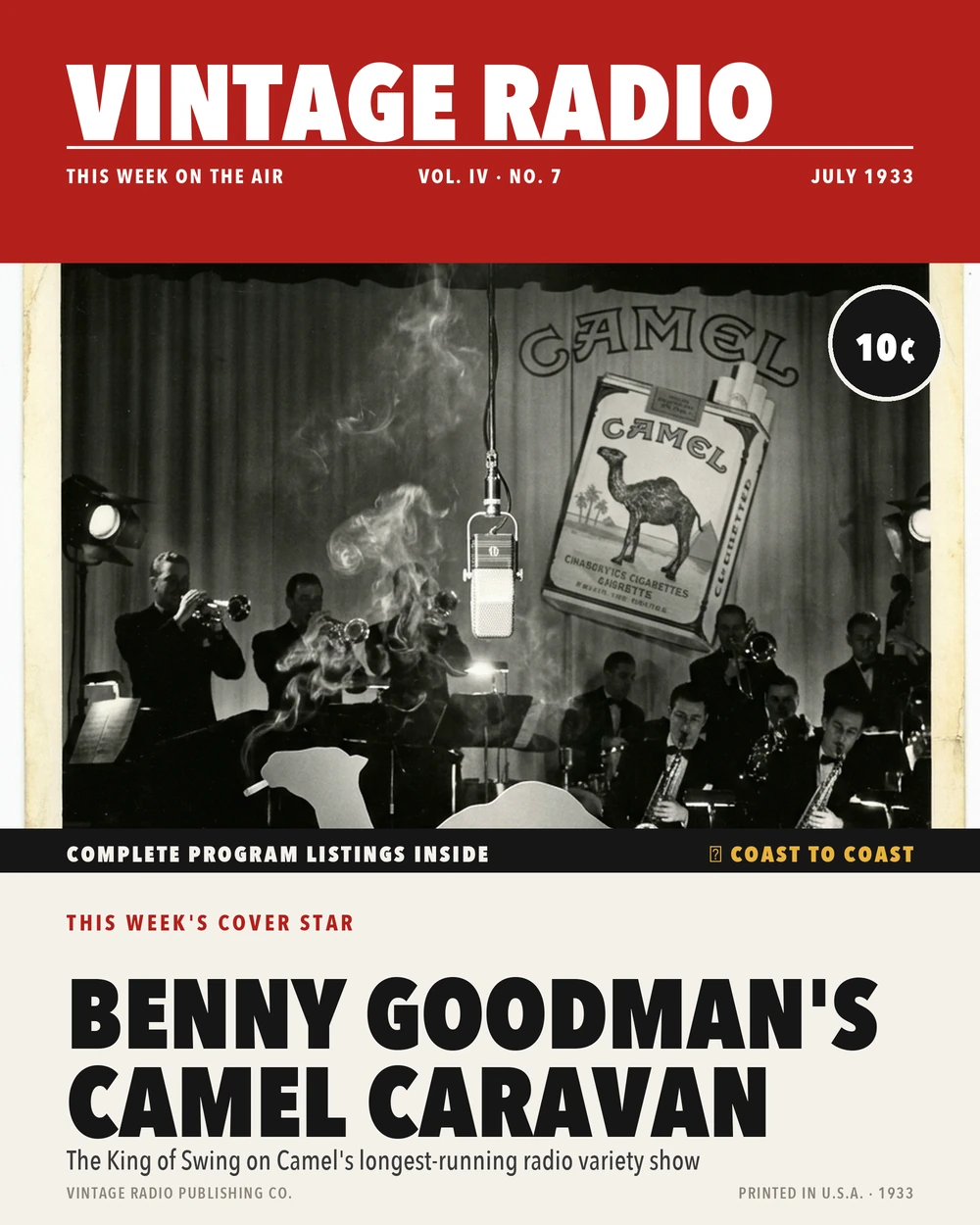
Benny Goodman's Camel Caravan
A Title That Traveled Everywhere
The Camel Caravan wasn't one show — it was a brand that R.J. Reynolds Tobacco kept pinning to whatever radio entertainment it was sponsoring at the moment. From December 7, 1933 to April 5, 1954, the Camel Caravan name traveled across CBS and NBC, attached to big bands, comedy programs, quiz shows, and variety hours. The performer changed. The format changed. The network sometimes changed. The sponsor never did. For 21 years, Camel cigarettes kept the title on the air in one form or another, making it one of the longest-running sponsored programs in American broadcast history.
What holds the sprawling run together isn't a single star or a consistent format — it's R.J. Reynolds's willingness to rebrand whatever was working, or to pivot quickly when something wasn't. When a comic fell ill, a replacement act was on the air within two weeks. When a band's ratings slipped, a new bandleader took the slot. The Camel Caravan was less a show than a strategy: keep the name in front of listeners, whatever it takes.
How It Started: Glen Gray and the Casa Loma Orchestra
The original Camel Caravan was built around Glen Gray and the Casa Loma Orchestra, a cooperative band that had incorporated in March 1930, electing Gray as president and leader. The orchestra's theme song, "Smoke Rings" — composed by band arranger Gene Gifford and first recorded in March 1932 — opened and closed every broadcast throughout the 1933–1936 run. Northeastern University's archives recognize the Casa Loma Orchestra's Camel Caravan tenure as the first radio commercial series to feature a swing band, which gives the original incarnation a place in broadcast history that goes beyond its ratings.
The first episodes aired Tuesdays and Thursdays at 10 on CBS, in 30-minute installments. Deane Janis handled vocal duties, and by 1934, comedy team F. Chase Taylor and Budd Hulick — performing as their characters Col. Stoopnagle and Budd — joined the show. Walter O'Keefe also appeared for comedy from 1934 through 1936. Gray himself didn't formally take over as front-man until 1937, when he stepped out of the saxophone section to replace violinist Mel Jenssen, who had previously conducted while Gray played.
Benny Goodman Takes Over
When Camel decided to replace Glen Gray's orchestra in the summer of 1936, Benny Goodman was the obvious choice. Born Benjamin David Goodman in Chicago on May 30, 1909, he had spent the previous year turning his band into a national phenomenon. His landmark performance at the Palomar Ballroom in Los Angeles on August 21, 1935 is widely cited as the beginning of the Swing Era. The band had used its earlier exposure on NBC's Let's Dance — a three-hour weekly program that ran from December 1934 to May 1935 — to build a following on the West Coast before that show's cancellation. After a season broadcasting from Chicago's Congress Hotel, Goodman had enough national profile to be handed the Camel slot.
He stepped into the Caravan on June 30, 1936, at the same time his band moved to Hollywood to film Paramount's The Big Broadcast of 1937. Biographers Connor and Hicks would later describe this CBS run as Goodman's "third and greatest sponsored radio show." The premiere was a full-dress affair: Nathaniel Shilkret's orchestra shared the bill alongside Goodman's band, with novelist Rupert Hughes as Master of Ceremonies and opera soprano Gladys Swarthout as the first guest artist, as noted in a Los Angeles Times picture caption from the date. Shilkret left by September 22, 1936, leaving Goodman as the sole headliner, and the show then took on a "Swing Club" format, structured as weekly club meetings featuring the Benny Goodman Quintet and other ensembles.
During his 1935–1936 Chicago broadcasts, Goodman had been introduced as "the Rajah of Rhythm." By 1937, Time magazine had settled on something stickier: "The King of Swing." On January 16, 1938, midway through his Camel Caravan tenure, Goodman played Carnegie Hall in a sold-out concert that was broadcast on national radio. Critic Bruce Eder has described it as "the single most important jazz or popular music concert in history."
The Goodman Band on Air
The vocalists and sidemen heard on the Goodman Caravan read like a roll call of the era's most significant jazz musicians. Martha Tilton and Johnny Mercer both sang on the show during the 1936–1939 CBS run, with Mildred Bailey also appearing. The instrumental lineup included trumpeters Ziggy Elman, Harry James, and Chris Griffin; pianists Teddy Wilson and Jess Stacy; vibraphonist Lionel Hampton; and drummer Gene Krupa. Goodman was also leading one of the first racially integrated jazz ensembles of the period — Teddy Wilson had first appeared publicly with the Goodman Trio at the Congress Hotel in 1935, and Lionel Hampton joined the Goodman Quartet in 1936.
For the spring 1939 season, Mercer's role was elevated to co-host, heading a fictional listener group called "The Hot Club." The band and Mercer toured metropolitan theaters, broadcasting live from venues in Philadelphia, Chicago, Hartford, Indianapolis, Pittsburgh, and other cities. Billie Holiday also appeared during this period, performing "I Cried for You" on a January 17, 1939 broadcast — one more name in a stretch of programming that was pulling from the deepest end of the jazz talent pool.
The ratings during the Goodman years were respectable but not dominant. The 1936–1937 season, when Goodman shared billing with the linked comedy program Jack Oakie's College — Camel sponsored both and billed the combined hour as a single Camel Caravan — earned a combined rating of 9.6 and a Top 30 ranking. By the 1938–1939 season, the show posted a Hooper rating of 8.6, good for 55th nationally; for context, Fibber McGee & Molly was in the Top Five with a 17.6. The NBC Saturday night run in 1939–1940, Goodman's final Camel season, held the 8.6 rating but fell to 78th place. Louise Tobin replaced Martha Tilton for that NBC run, and Helen Forrest also appeared during the transition.
The Revolving Door of Bandleaders
Bob Crosby stepped into Goodman's slot on June 27, 1939, when the Camel Caravan moved to NBC. Crosby — born August 23, 1913, in Spokane, Washington, and the younger brother of Bing — led a Dixieland-rooted band that stood apart from the dominant swing style of the era. Bert Parks served as emcee from 1939 to 1940. Dorothy Claire handled radio vocal duties for Crosby's band while Marion Mann performed on stage; Johnny Mercer and Helen Ward also backed Claire during the early weeks. Down Beat magazine reported that in July 1940, Doris Day — then singing with Crosby — was replaced by Bonnie King, though accounts differ on whether Day left voluntarily or was dismissed over a salary dispute.
Xavier Cugat's orchestra followed Crosby beginning January 9, 1941, with the show now on NBC on Thursdays at 7:30. Cugat stayed through the next shift to CBS in July 1942, at which point the show expanded to 60 minutes and aired on Fridays at 10. Freddie Rich eventually replaced Cugat as orchestra leader during that CBS run. Comedian Herb Shriner brought a Hoosier-inflected style of humor to the 1942–1943 CBS incarnation, alongside vocalists Connie Haines and Lanny Ross, with Ken Niles announcing. Jack Carson hosted a separate 45-minute Camel Comedy Caravan on CBS from March to July 1943, with Ken Niles again announcing, Elvia Allman playing the character Mrs. Ken Niles, and Mel Blanc turning up in roles ranging from an Irish cop to Pancho the Mexican to an English butler named Jerkins.
Durante and Moore: The Show Finds Comedy
The most unexpected pivot in the Camel Caravan's history came in March 1943. Lou Costello of Abbott and Costello had fallen ill with severe rheumatic fever, leaving a hole in the NBC Camel Caravan lineup. Director-producer Phil Cohan had noticed the contrast between veteran comedian Jimmy Durante — then performing at New York's Copacabana — and up-and-coming comedian Garry Moore during an NBC broadcast, and approached both about teaming up. The pairing was rushed into production in two weeks, and the duo premiered on NBC on March 25, 1943.
The chemistry was immediate and distinctive. Durante's comedic persona earned him "The Nose" while Moore became "The Haircut." Durante habitually called Moore "Junior," and the catchphrase "Dat's my boy dat said dat!" spread widely enough that many listeners believed the two were actually father and son. The catchphrase reportedly inspired the later Hanna-Barbera cartoon Augie Doggie and Doggie Daddy. The show moved to CBS in October 1943, running as The Camel Comedy Caravan on Fridays at 10. By 1947–1948 it had reached the top ten nationally, tying for 7th place alongside Philco Radio Time and Dr. Christian. Georgia Gibbs — born Frieda Lipschitz on August 17, 1919, in Worcester, Massachusetts — was a regular performer throughout the Durante-Moore run from 1943 to 1947. Camel's sponsorship of the program ended after the March 30, 1945 broadcast, with Rexall Drugs taking over the following week, though Camel later resumed sponsorship of The Jimmy Durante Show in the fall of 1948.
The Long Finale: Vaughn Monroe
After Durante and Moore, the Camel Caravan title was most durably attached to Vaughn Monroe — a baritone singer, trumpeter, and big band leader whose signature tune was "Racing with the Moon." Monroe hosted under the banner of The Vaughn Monroe Show, sometimes billed as The Camel Caravan, from July 4, 1946 to April 5, 1954. He broadcast from The Meadows, his own restaurant and nightclub on Route 9 in Framingham, Massachusetts, and also appeared in Camel cigarettes commercials during this period. Georgia Gibbs was among the vocalists performing with Monroe's orchestra. From 1950 to 1951, Monroe's radio run overlapped with a CBS television version of The Vaughn Monroe Show, with both carrying the Camel Caravan name. The New England Conservatory of Music holds his collection — roughly 1,300 acetate disc recordings and 48 reel-to-reel tapes, along with 2,148 band arrangements used on the radio and television programs.
When the Monroe show ended in April 1954, the Camel Caravan finally closed after more than two decades on the air. Over those 21 years, it had employed Glen Gray, Benny Goodman, Bob Crosby, Xavier Cugat, Jimmy Durante, Garry Moore, Jack Carson, Bob Hawk, Vaughn Monroe, and dozens of vocalists, comedians, and sidemen. The title had moved between CBS and NBC more than once, shifted formats from pure music to comedy to quiz shows, and stretched from 30 minutes to a full hour depending on what the moment called for. What never changed was the sponsor's name, or the Camel Caravan sign hanging over whoever happened to be on stage.